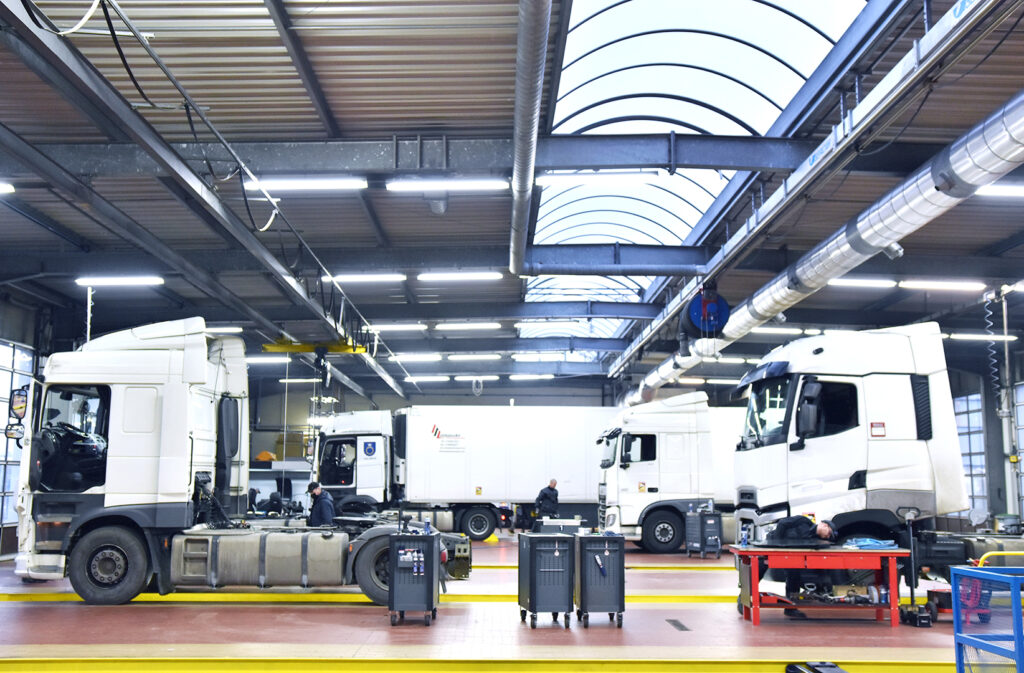
For many transport companies, purchasing a new or used truck seems like a decisive milestone. The contract is signed, the vehicle is collected, the paperwork is completed – operations can begin. However, the first months of operation often reveal that the purchase itself was only the beginning, not a guarantee of smooth performance.
“Buying a vehicle and assigning a driver to it is not enough – there is essential groundwork that must be completed before the actual start,” says Evaldas Sparnauskas, Service Foreman at the truck repair center network of UAB Trelo.
Manufacturer inspection and real-life operation are not the same
A truck leaving the factory undergoes what is known as a PDI (pre-delivery inspection). During this procedure, the vehicle is technically prepared for operation: key components are checked, software is configured, and control tests are performed.
However, as the Trelo expert points out, PDI does not mean that the truck is perfectly adapted to a specific operational context.
“The manufacturer prepares the vehicle according to standard parameters. But in reality, there is no such thing as ‘average operation.’ Routes differ, loads differ, climate conditions vary, and so does work intensity,” explains E. Sparnauskas.
When purchasing used equipment, the situation becomes even more complex – the actual condition must be assessed by the buyer or by specialists chosen by them.
Additional equipment is not just a formality
In modern logistics, a truck rarely starts operating without additional equipment. Toll devices, tracking systems, and various control modules have become standard practice. However, their installation requires precision.
“It may seem simple – just connect the device to a power source. But improper wiring can cause disruptions in other systems or even damage original equipment,” emphasizes the Trelo representative.
According to him, toll equipment should be connected to a separate, stable power supply rather than to standard 12/24V cabin sockets. Tracking systems must also be integrated in accordance with the manufacturer’s requirements, ensuring proper connection of both data and power lines.
Informational markings are part of technical discipline
Another frequently underestimated area is mandatory informational markings and stickers. Different countries apply different requirements, and failure to comply can result in significant fines.
“For example, when driving through France, ‘Angles Morts’ blind spot warning stickers are mandatory. Improper use can result in a fine of up to €750,” reminds E. Sparnauskas.
Although not directly related to mechanical failures, such formalities have a direct impact on operational safety and business risk management.
Minor mistakes that turn into real problems
Service center practice shows that even new trucks after PDI may have shortcomings.
“In repair centers, we regularly encounter human errors – antennas not properly tightened, allowing water to leak into the cabin; loose hydraulic hoses; oil leaks from unsecured components,” lists Trelo’s Service Operations Manager E. Sparnauskas.
Such inconsistencies are often not noticed immediately. The vehicle operates, but not in an optimal mode. Over time, this results in faster component wear, unstable operational economics, and less predictable repair costs.
According to E. Sparnauskas, a breakdown is rarely the first symptom. “Initially, increased costs appear – fuel, repairs, downtime. Only later does the problem become technically evident.”
A truck is not just a vehicle, but a financial asset
From a business perspective, a truck should be viewed not merely as a mechanical unit, but as a financial asset. Like any asset, it requires not only acquisition but systematic management.
“Preparing a vehicle for operation is not a technical formality or an additional cost. This is particularly important when purchasing used trucks, where a full technical inspection should be understood as a necessary stage. In logistics, the goal is simple – to move, not to stand still. Everything ultimately comes down to proper risk, cost, and operational stability management,” concludes E. Sparnauskas.
This is precisely the approach promoted by Trelo, whose repair centers demonstrate daily that preventive decisions often lead to more stable and predictable fleet economics.